

Departments of Corrections (DOCs) operate in high-stakes environments where split-second decisions can have significant consequences for the safety of both personnel and residents. The primary challenge in these facilities often stems from the fact that modern offender records management systems are frequently fragmented across various platforms including medical, mental health, and case management modules. When a correctional officer or a mental health professional cannot access a complete, real-time profile of an individual due to data silos, it creates a blind spot that compromises safety. By implementing a smarter architectural approach that connects these disparate data points into a centralized workflow layer, agencies can ensure that staff have the information they need exactly when they need it.
The High Cost of Fragmented Information
The current reality for many Departments of Corrections is a digital landscape defined by isolation. Information regarding an individual’s journey through the justice system is often scattered across an offender management system (OMS), separate case management systems, and distinct medical and mental health systems. While each of these platforms serves a mission-critical purpose, they rarely talk to one another in a meaningful way. This fragmentation means that a staff member might be reviewing a case file in one system while vital medical alerts or behavioral warnings remain hidden in another.
When records are fragmented, the administrative burden on staff increases exponentially. Instead of focusing on rehabilitation or facility security, employees spend an inordinate amount of time manually searching for documents, cross-referencing entries, and responding to internal or external audits. This inefficiency does more than just hurt productivity; it creates a culture of information poverty where the most relevant data is the hardest to find. In a correctional setting, the lack of a unified record is not just a clerical headache—it is a risk factor.
A Smarter Architectural Approach to Modernization
Modernizing a DOC’s digital infrastructure does not necessarily mean undergoing the risky and expensive process of ripping and replacing core legacy systems. In fact, such drastic measures often lead to operational instability. A more practical view of modern records management focuses on connectivity rather than replacement. By positioning a platform like OnBase as a centralized content and workflow layer, agencies can leave their existing authoritative systems in place while creating a single pane of glass for information access.
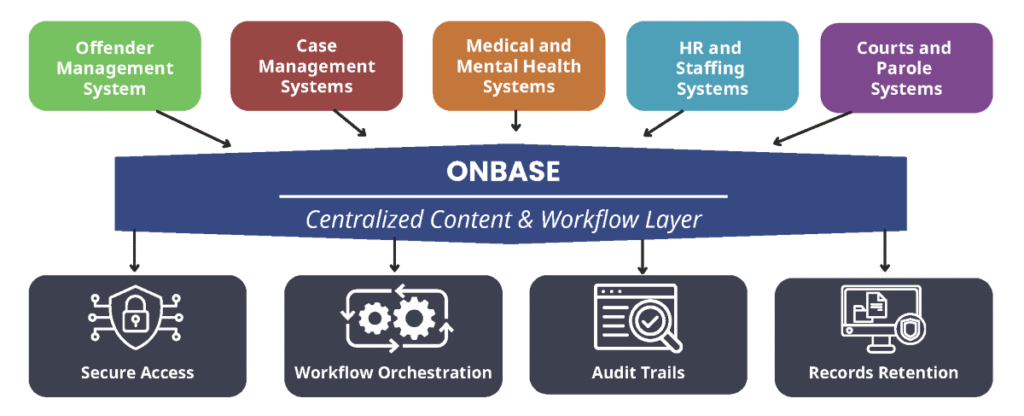
In this architectural model, the offender management system remains the primary tool for intake and housing, and the medical systems remain the authoritative source for health data. However, the centralized layer pulls the relevant documents and data into a unified stream. This allows for workflow orchestration, where tasks move seamlessly between departments without the need for manual hand-offs or paper-based processes. It ensures that if a parole update is logged or a legal hold is placed by the courts, that information is instantly visible to those managing the offender’s daily activities.
Interested in how this architectural approach could apply to your agency’s offender records environment? Download the full DOC Architectural Insight to learn more about how we unify fragmented systems.
Enhancing Operational Stability and Staff Confidence
One of the most significant benefits of this connecting layer approach is the preservation of operational stability. Correctional staff are often resistant to new software because the learning curves are steep and the transition periods can be chaotic. By using a unifying layer, the mission-critical systems staff use daily remain unchanged, but their functionality is augmented. This reduces the duplication of data and documents, which is a major source of error in offender tracking.
When staff members know that the information they are looking at is the most current and complete version available, their confidence increases. This reliability is essential during crisis interventions or high-pressure situations where staff must know the mental health status or disciplinary history of an individual before engaging. Furthermore, this architecture supports scalability. As policies change or staffing levels fluctuate, the centralized layer can be adapted to new workflows without requiring a complete overhaul of the underlying database structures. It also paves the way for cloud readiness, allowing agencies to move toward more secure and accessible off-site hosting at their own pace.
Reducing Risk through Centralized Control
Beyond immediate physical safety, there is the matter of institutional and legal safety. DOCs are under scrutiny from the courts, parole boards, and the public. A centralized records architecture provides a robust risk reduction framework that fragmented systems simply cannot match. Centralized access controls ensure that sensitive medical or legal information is only viewed by authorized personnel, maintaining compliance with privacy laws while still allowing for operational visibility.
Perhaps most importantly for administrative staff, this approach creates defensible audit trails. Every time a record is accessed, edited, or moved, the system logs the action. This makes responding to investigations or operational audits much faster and less prone to human error. Instead of spending weeks pulling together a paper trail, administrators can generate a comprehensive report in minutes. Coupled with consistent retention enforcement, which ensures that records are kept or destroyed according to state and federal laws, the agency significantly lowers its litigation risk.
Bridging the Gap Between Courts, Parole, and Facilities
The offender lifecycle does not exist solely within the walls of a correctional facility. It involves a constant exchange of information with external justice partners, including the courts and parole systems. In a traditional, fragmented model, the delay in receiving a court order or a parole notification can lead to improper releases or, conversely, the unlawful extension of a stay. Both scenarios carry immense legal and safety risks.
A centralized workflow layer bridges this gap by providing a secure gateway for external systems to feed information into the facility’s ecosystem. This creates a seamless flow of data where secure access is the priority. When a parole board makes a decision, that record can be automatically routed into the centralized system, triggering a specific workflow for the facility staff. This level of automation removes the human error factor of a clerk forgetting to scan a document or a fax getting lost in a pile. It ensures that the record is the source of truth for everyone involved.
The Role of 3SG Plus in Designing Offender Records Management Architecture
Designing an architecture that balances the needs of IT, administration, and frontline staff requires a partner who understands the unique pressures of the correctional environment. 3SG Plus specializes in helping agencies design and implement these offender records architectures. The goal is not just to install software, but to align the technology with real-world workflows.
By focusing on OnBase as a unifying layer, 3SG Plus helps agencies modernize their records management while preserving the stability of the platforms they have already invested in. Our practical approach recognizes that DOCs cannot afford downtime or data loss. The transition to a centralized content and workflow layer is handled as a strategic evolution rather than a disruptive revolution. This methodology ensures that the offender lifecycle—from intake to parole—is documented accurately and accessible instantly.
Conclusion: Prioritizing Information for a Safer Environment
The safety of correctional staff is directly linked to the quality of the information they possess. While the complexity of offender management will always exist, the technology used to manage it should simplify, not complicate, the daily lives of those on the front lines. By moving away from fragmented silos and toward a centralized content and workflow layer, DOCs can achieve a level of operational clarity that was previously impossible. This architectural shift provides the secure access, audit trails, and records retention capabilities needed to thrive in a modern legal and social climate.
Investing in a unified records architecture is more than a technical upgrade; it is a commitment to the well-being of staff and the integrity of the justice system. It allows agencies to reduce data duplication, enforce consistent workflows, and respond to the demands of the public with transparency and speed. As we look toward the future of corrections, the ability to connect information across the offender lifecycle will be the defining factor in institutional success.