

Modern inspection programs depend on speed, accuracy, and visibility to protect public safety and maintain regulatory compliance. For many agencies, the transition from legacy systems to a unified digital platform is a fundamental necessity for operational survival. By modernizing inspection workflows, local governments can move beyond the constraints of paper-based processes and embrace a future defined by data-driven decision-making. The Accela Civic Platform serves as both a system of record and a system of action that replaces manual scheduling and delayed data entry with a unified inspection workflow that supports inspectors in the field and leadership in the office. This transformation allows organizations to move from simple permit processing to high-level performance management, ensuring that every data point collected contributes to the broader mission of civic excellence.
The Limitations of Manual and Disconnected Inspections
The traditional approach to inspections is often characterized by a series of disconnected steps that hinder productivity and create significant backlogs. In the “before” state of most agencies, the workflow begins with manual inspection creation that often require an exhaustive manual entry review. The reliance on human intervention at this early stage introduces a high risk of data errors and consumes valuable administrative hours that could be better spent on higher-value tasks. Scheduling these inspections typically involves a chaotic mix of spreadsheets and phone calls, making it difficult to optimize routes or ensure that the right inspector is assigned to the right location at the right time. This lack of structure leads to inefficient travel paths and wasted fuel, further draining agency resources.
Once an inspector arrives at a site, the challenges continue with the use of paper checklists and the need to take separate photos on external devices. Fragmented data collection means that when an inspector finishes their field work, their job is far from over. They must return to the office to re-type data into a computer system, a redundant process that leads to further delays and the potential for lost or misinterpreted information. Furthermore, manual follow-ups and the lack of automated reminders frequently result in missed deadlines and lapsed compliance. From a leadership perspective, reporting in this environment is delayed and provides very limited visibility into the actual performance of the department. The ultimate results of these disconnected systems are significant backlogs, persistent data delays, and a lack of accountability across the organization.
Transitioning to an Accela-Enabled Inspection Process
Utilizing the Accela Civic Platform for inspection processes represents a paradigm shift in how civic operations can be managed. Instead of manual data entry, the system utilizes automatic inspection creation through a centralized case record, ensuring that no manual entry is required to initiate a workflow. This automation extends to the scheduling phase, where rules-based assignments are used to optimize how inspectors are deployed across a jurisdiction. By leveraging these intelligent tools, agencies can ensure that their field staff is operating at peak efficiency, reducing travel time and increasing the number of inspections completed per day. This optimization is crucial for agencies trying to keep up with increasing demand without necessarily increasing their staff headcount.
The field experience is also transformed through mobile field inspection capabilities. Inspectors can use digital checklists and collect photos directly within the mobile application, ensuring that all evidence and observations are tied to the record in real-time. This digital-first approach allows for standardized violations and notices to be generated immediately, complete with automated deadlines. Because the system tracks every step from assignment through closure, follow-ups are no longer left to chance. Automated reminders and re-inspection triggers ensure that compliance is met without the need for manual tracking. For agency leaders, real-time reporting and visibility with live dashboards and metrics provides a single source of truth for the entire department and allows for more agile resource management.
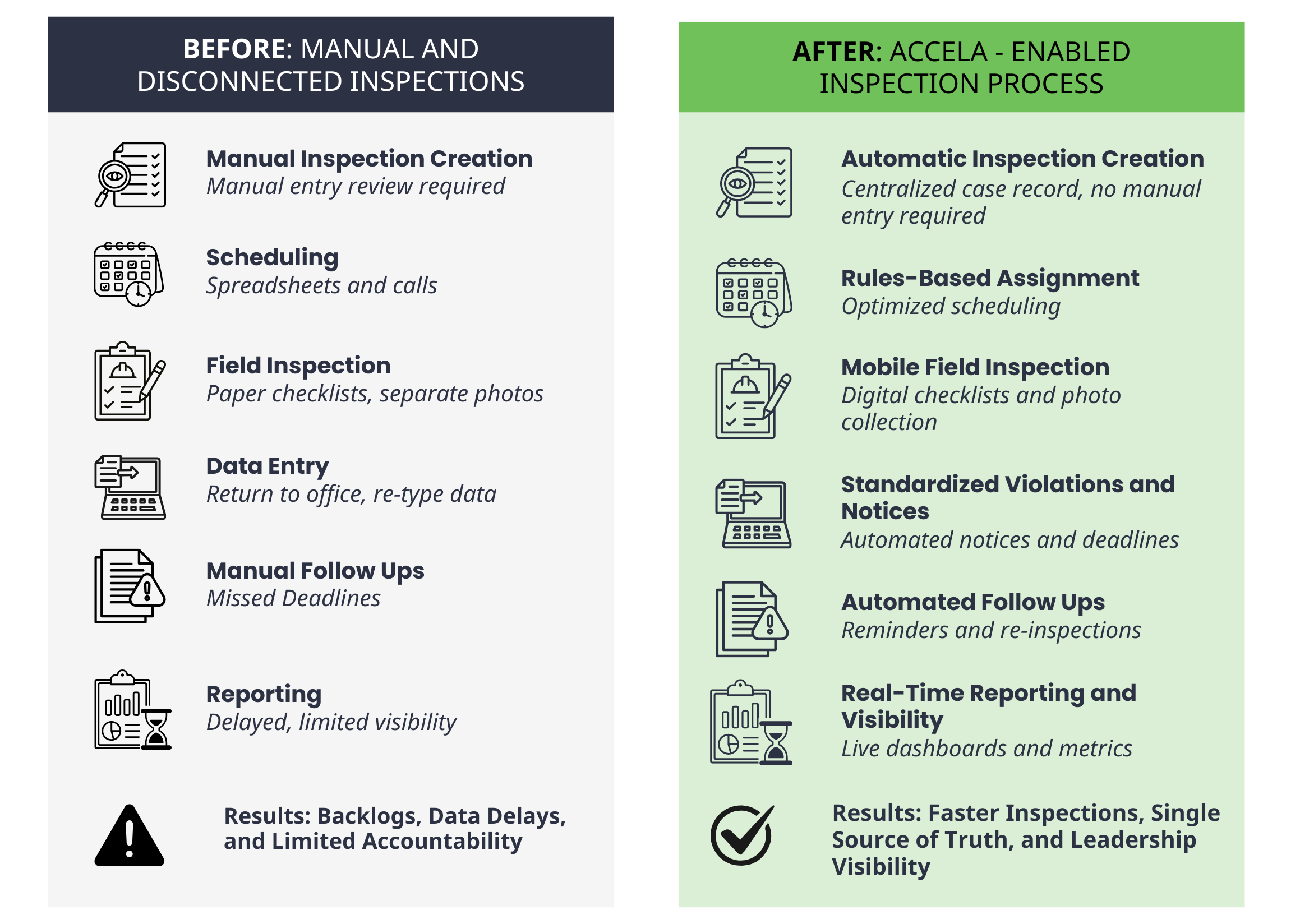
Click the button below to download this image and the full “Reimagining the Inspection Workflow Process” document.
Enhancing Performance Through Configuration
A key component of modernizing civic operations is the shift from heavy customization to agile configuration. Accela is designed to be highly configurable, allowing it to match specific inspection types, jurisdictional rules, and unique field conditions without the need for complex, expensive custom coding. Detailed configuration ensures that the resulting workflows are not only technologically advanced but also practical for the inspectors who use them every day. When a system is configured to align with existing department rules, it encourages consistency across different teams and maintains strict adherence to reporting and compliance requirements. This consistency is vital for maintaining public trust and ensuring that all businesses or properties are held to the same standard.
Configuration also allows for faster permitting, inspections, and licensing since Accela software is tailored to the specific needs of various regulatory bodies. Furthermore, by integrating Accela with enterprise content management (ECM) systems and various reporting tools, agencies can achieve enterprise-wide visibility. Integration with existing business systems ensures that documents are stored securely and are easily accessible across the organization, breaking down silos and fostering a culture of transparency. When a system “just works” in the real world from day one, it builds trust with both the staff and the public they serve. From assignment through closure, every step is tracked and reportable; so agencies can keep up with demand and provide leadership with the live metrics needed to make informed decisions.
Achieving Enterprise-Wide Visibility and Accuracy
To fully appreciate the impact of a reimagined workflow, one must consider the cascading benefits of data accuracy. In a manual system, a single transposed digit in a field report can lead to weeks of administrative confusion, potentially delaying a business opening or leaving a safety violation unaddressed. By utilizing mobile field inspection tools, the data is validated at the point of entry. If a required field is missing or a measurement falls outside of acceptable parameters, the system can alert the inspector immediately. An immediate feedback loop is a hallmark of a “system of action,” preventing errors before they ever enter the permanent record. It ensures that the data used for reporting is high-quality and reliable from the moment it is captured.
Furthermore, the environmental and organizational impact of transitioning away from paper-based checklists is significant. Moving to digital checklists not only reduces the physical footprint of the office but also simplifies the archival process significantly. With Accela, every inspection, photo, and notice is stored within a centralized case record, making it searchable in seconds rather than hours or days. This accessibility is vital for responding to public records requests or preparing for audits, ensuring that the agency remains compliant with transparency laws. The unified workflow ensures that from assignment through closure, every step is standardized, reportable, and accessible to those who need it.
Empowering the Modern Field Workforce
The human element of this transition is equally critical. Inspectors often face high-pressure environments, difficult site conditions, and heavy workloads. By removing the “homework” aspect of their jobs, agencies can significantly improve staff morale and retention. When technology acts as a support tool rather than a hurdle, it allows professionals to focus on their expertise: identifying risks, educating the public, and ensuring safety. The hallmark of a successful agency is its ability to empower its workforce with the best possible tools to perform their duties efficiently and accurately.
Empowerment leads to better community outcomes. When inspectors spend less time on paperwork, they have more time for high-quality inspections and proactive community engagement. Integrating Accela with existing ECM systems represents the final piece of the digital transformation puzzle. By creating a unified ecosystem where information is no longer scattered across various silos like email inboxes or physical filing cabinets, agencies can ensure that all relevant documentation is automatically linked to the correct permit or case file. This enterprise-wide visibility allows different departments to collaborate more effectively, ensuring that no department is working in a vacuum and that the public receives a consistent experience.
3SG Plus: Your Accela Partner
While the Accela platform provides the powerful foundation for a modern inspection system, the expertise of a partner like 3SG Plus is what turns these capabilities into tangible operational improvements. We work closely with agencies to ensure that their workflows are not just modern on paper, but functional and sustainable in the long term. Our partnerships with clients provide the credibility and technical proficiency needed to navigate complex regulatory requirements and enterprise-level deployments. By focusing on practical application and jurisdictional alignment, we ensure that workflows are intuitive for inspectors and consistent across departments.
The ability to scale operations through technology is a cornerstone of performance-driven government. By moving away from manual, disconnected processes, agencies can focus their resources on their core mission: protecting the community. The shift to a unified, digital workflow results in faster inspections, improved data accuracy, and a clear, reportable trail of accountability for every action taken in the field. Adopting a system of action like Accela is the most effective way to ensure long-term success and compliance. 3SG Plus helps agencies turn these capabilities into real operational improvements, ensuring that the technology serves the mission, rather than the other way around.
Conclusion
Reimagining the inspection workflow is about more than just replacing paper with screens; it is about creating a cohesive, intelligent system that supports the vital work of field inspectors and agency leaders alike. By addressing the bottlenecks of manual scheduling, data re-entry, and limited reporting, Accela provides a path toward a more responsive and transparent government. This move from “Permits to Performance” allows agencies to modernize their civic operations and meet the demands of the future.
With the right configuration and the support of an experienced partner like 3SG Plus, agencies can transform their field operations into a high-performance engine of public service. The result is not just a modern inspection system, but a workflow that actually works in the real world—day one and long term. Providing a single source of truth offers the visibility required to lead with confidence and ensures that every inspection is an opportunity for improved community outcomes and long-term operational excellence.