

Correctional institutions manage some of the most complex, high-risk records in the public sector. From the moment an individual enters custody through release and post-supervision, every interaction generates documentation that must be accurate, accessible, secure, and legally defensible. Offender record lifecycle management is not simply a records issue—it is an operational, compliance, and public safety imperative. When records are fragmented across systems, paper files, and manual workflows, agencies expose themselves to unnecessary risk, inefficiency, and lost institutional knowledge.
Enterprise content management (ECM) solutions like OnBase by Hyland provide a foundational framework for managing offender records as a continuous lifecycle rather than a series of disconnected events. Instead of treating intake, housing, discipline, programs, and release as separate documentation challenges, ECM enables a single, authoritative digital record that evolves with the offender. ECM strengthens accountability, supports staff decision-making, and ensures compliance with retention and disclosure requirements.
Why the Offender Record Lifecycle Demands a Holistic Approach
Offender records are dynamic by nature. They change as custody levels shift, incidents occur, programs are completed, and legal statuses evolve. Yet many Departments of Corrections (DOCs) still rely on siloed systems, shared drives, paper files, or department-specific databases that fail to reflect the full story of an offender’s journey. This fragmentation forces staff to search across systems, duplicate documentation, or rely on outdated information.
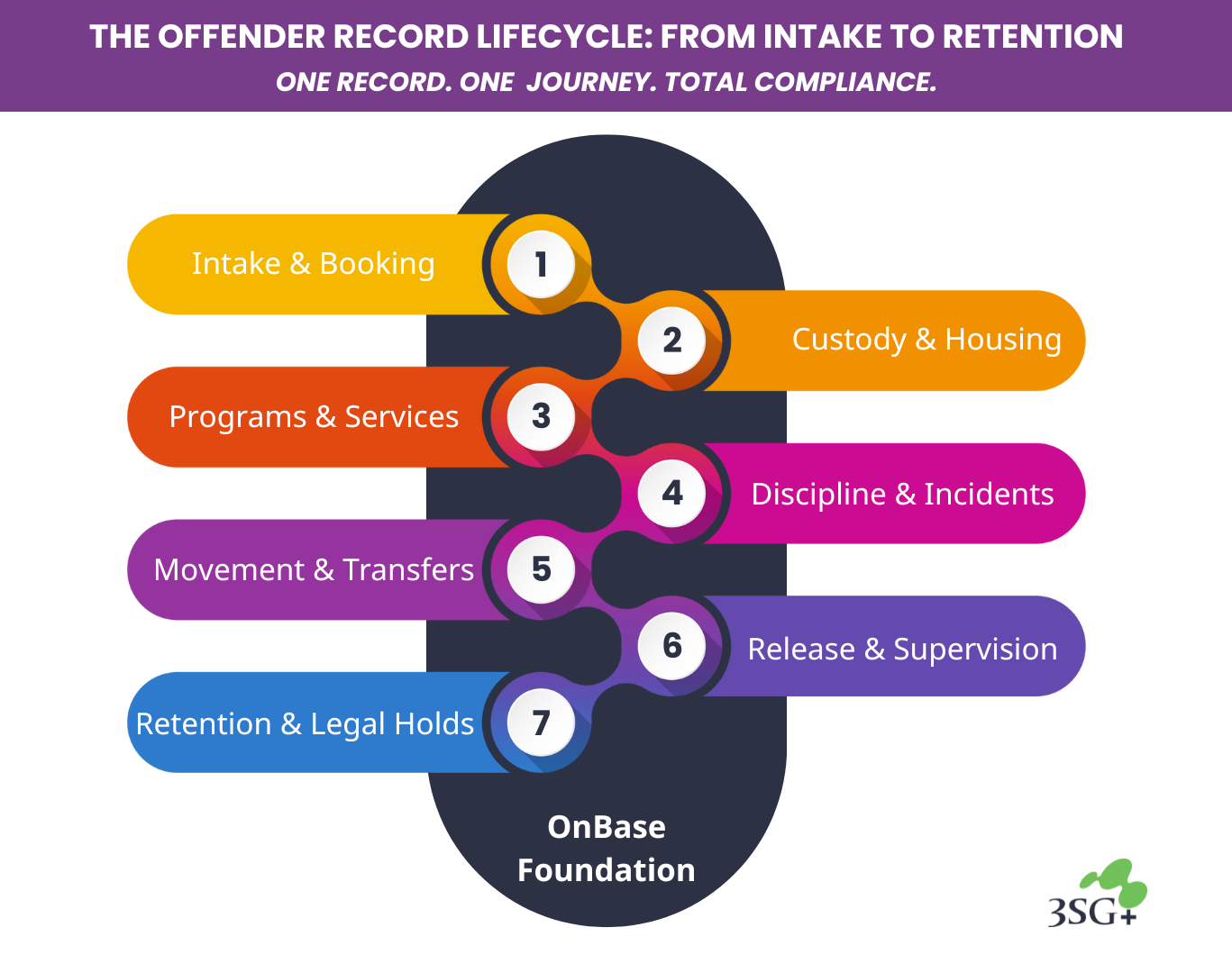
A holistic offender record lifecycle model treats every document, form, report, and artifact as part of a single record continuum. ECM supports the holistic model by centralizing content, applying consistent metadata, and enforcing governance policies across the entire lifecycle. The result is a record that follows the offender—not the department—ensuring continuity, accuracy, and defensibility regardless of where or how the information is created.
Intake and Booking: Establishing a Digital Source of Truth
The intake and booking process sets the foundation for the entire offender record. Errors or omissions at this stage can cascade throughout the lifecycle and impact classification decisions, housing assignments, medical care, and legal outcomes. ECM enables agencies to digitize intake documentation at the point of entry to ensure that critical information is captured accurately and immediately.
By integrating ECM with intake systems and scanning processes, agencies can automatically index documents like arrest records, warrants, identification, medical screenings, and classification assessments. These documents become instantly accessible to authorized staff across facilities, reduce delays, and eliminate redundant data entry. More importantly, ECM ensures that the intake record becomes the authoritative source of truth that all downstream processes rely upon.
Custody and Housing: Supporting Daily Operations with Real-Time Access
Once an offender is in custody, records become operational tools used by correctional officers, supervisors, medical staff, and administrators. Housing decisions, security classifications, and supervision levels depend on timely access to accurate information. ECM enables real-time access to offender records while enforcing strict role-based access controls.
Rather than relying on paper files stored in control rooms or administrative offices, staff can retrieve up-to-date records directly within their workflows. Automated document routing ensures that housing changes, classification reviews, and supervisory notes are properly logged and retained. This level of visibility improves operational efficiency and strengthens institutional accountability by creating a clear audit trail of decisions and actions.
Programs and Services: Connecting Participation to Outcomes
Educational, vocational, behavioral health, and rehabilitative programs generate critical documentation that directly impacts offender outcomes. However, program records are often stored separately from core custody files, limiting visibility and long-term value. ECM bridges this gap by integrating program documentation into the offender’s central record.
Program enrollment forms, attendance records, evaluations, certificates, and progress reports can all be managed within ECM and linked to the offender’s profile. This allows staff to view participation history alongside custody data, supporting informed decisions related to classification, parole eligibility, and reentry planning. Over time, ECM enables agencies to analyze program effectiveness and demonstrate how services contribute to rehabilitation and reduced recidivism.
Discipline and Incidents: Creating Defensible Records
Few areas carry more institutional risk than disciplinary actions and incident reporting. Incomplete documentation, missing approvals, or inconsistent handling can lead to grievances, litigation, or external scrutiny. ECM provides structure and automation to ensure disciplinary and incident records are complete, consistent, and defensible.
Automated workflows guide reports through required reviews, approvals, and notifications, reducing the likelihood of procedural errors. Supporting evidence like photos, videos, witness statements, and medical reports can be securely attached to incident records to create a comprehensive case file. With ECM, agencies can demonstrate compliance with policy and due process requirements while protecting both staff and offenders.
Movement and Transfers: Maintaining Continuity Across Facilities
Offender movement between housing units, facilities, or jurisdictions introduces significant risk when records do not move with the individual. ECM ensures continuity by maintaining a centralized record that remains accessible regardless of physical location.
Transfer documentation, transport logs, receiving reports, and inter-agency communications can be managed within ECM to provide visibility before, during, and after movement. Visibility and continuity support safer transfers, reduce administrative burden, and ensure that receiving facilities have immediate access to critical information. ECM also preserves a clear historical record of movements, supporting audits and investigations when needed.
Release and Supervision: Extending Records Beyond the Facility
The offender record lifecycle does not end at release. Parole, probation, and post-release supervision generate ongoing documentation that must be retained and accessible. Effective ECM practices enable agencies to extend the offender record beyond incarceration to maintain continuity between institutional and community-based operations.
Release documentation, supervision agreements, compliance reports, and violation records can all be managed within an ECM system to maintain a complete historical record and support collaboration between corrections, courts, and community partners with appropriate access controls. By preserving the full lifecycle record, agencies strengthen transparency and accountability long after release.
Retention, Legal Holds, and Compliance: Closing the Lifecycle
Retention and disposition are often overlooked until a records request, audit, or legal action arises. ECM enforces retention schedules and legal holds automatically, so records are retained for the appropriate duration and disposed of defensibly when permitted.
For DOCs, proper records retention is critical. ECM ensures compliance with state and federal regulations, public records laws, and internal policies. Legal holds can be applied across the offender record instantly, preventing accidental deletion and reducing institutional risk. When audits or litigation occur, agencies can respond confidently with complete, traceable documentation.
If your agency is looking to strengthen offender record lifecycle management, now is the time to rethink how records support operations, compliance, and outcomes. Download our Offender Record Lifecycle infographic to see how a unified ECM foundation connects every stage—from intake to retention—and supports defensible, compliant corrections operations.
Why ECM Is the Backbone of Offender Record Lifecycle Management
At its core, ECM transforms offender record lifecycle management from a reactive, document-centric function into a proactive, operational capability. By unifying records, workflows, and governance, ECM enables agencies to reduce risk, improve efficiency, and support their mission of public safety.
Rather than asking staff to work around disconnected systems, ECM works in the background—automating processes, enforcing policy, and ensuring information is available when and where it is needed. This foundation allows correctional agencies to focus on outcomes, not paperwork.
Conclusion: One Record, One Journey
Managing offender records as a single, continuous lifecycle is no longer optional for modern correctional institutions. The operational, legal, and reputational risks of fragmented records are simply too high. Effective ECM provides the structure and scalability needed to support every phase of the offender journey.
By adopting an ECM-driven approach to offender record lifecycle management, agencies gain more than efficiency. They gain confidence in their data, trust in their processes, and clarity in their decision-making. The result is a correctional environment that is safer, more transparent, and better equipped to meet the demands of today and tomorrow.