

Public sector agencies manage a complex web of community development and safety responsibilities ranging from intricate permitting and multi-stage inspections to long-range urban planning, professional licensing, and code enforcement. While these functions are the heartbeat of local government, the technical infrastructure supporting them often resembles a patchwork of disconnected silos rather than a cohesive network. This fragmentation creates a significant hurdle: when information is trapped within separate platforms, departments struggle to access complete records, maintain consistent cross-departmental workflows, and provide the rapid responses that modern public inquiries and audits demand. To solve these challenges, many forward-thinking organizations integrate the Accela Civic Platform with existing business systems to ensure the seamless flow of data across the entire enterprise and enhance transparency and operational agility.
The traditional approach to technology upgrades often involved a rip and replace philosophy, which frequently led to massive budget overruns, staff burnout, and significant downtime. However, modern agency architecture has evolved past this disruptive model. Today’s most effective digital transformations do not require abandoning core financial or geographic systems that have served an agency for years. Instead, the focus has shifted toward a smarter architectural approach that emphasizes connecting existing information and workflows to support both daily operations and long-term regulatory compliance. By viewing technology as an interconnected web rather than a series of isolated boxes, agencies can preserve their existing investments while gaining the advanced functionality required to meet 21st-century citizen expectations.
The Role of Accela as a Centralized Engagement Layer
The Accela Civic Platform functions as a centralized engagement and workflow layer. In this sophisticated ecosystem, your existing ERP, financial platforms, and geospatial (GIS) systems remain the authoritative records for their specific domains. Accela sits atop these foundations, acting as the connective tissue that ensures visibility, control, and continuity across the entire lifecycle of every record. This means that when a permit is issued or an inspection is completed, the data flows naturally between systems, updating financial ledgers and mapping layers automatically without requiring manual intervention from staff.
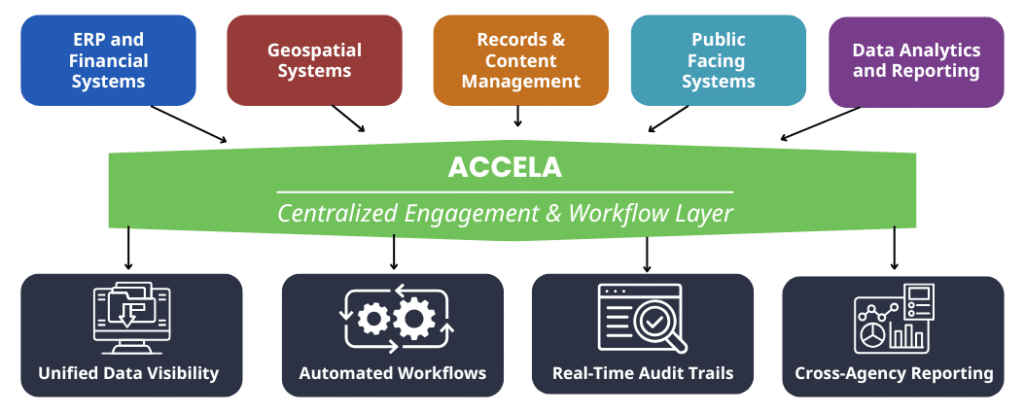
The power of this centralized layer lies in its ability to ingest data from diverse sources and present it through a unified interface. Whether the data is coming from Records and Content Management systems, Public Facing Systems, or Data Analytics and Reporting tools, Accela harmonizes these inputs. This architecture provides four primary pillars of value: unified data visibility, automated workflows that bridge departmental gaps, real-time audit trails for enhanced accountability, and comprehensive cross-agency reporting. By consolidating these functions into a single workflow layer, agencies can finally eliminate the data graveyard effect, where information is collected but never utilized to its full potential for decision-making.
Download the Full Visual Overview to see a detailed breakdown of how these systems interact and how you can map your agency’s path to modernization.
Achieving Operational Stability and Risk Reduction
One of the most immediate benefits of adopting the Accela ecosystem model is the preservation of operational stability. Because the platform is built to connect rather than disrupt, there is no sudden shock to mission-critical systems that staff rely on for their hourly tasks. This stability is bolstered by a significant reduction in data duplication; when systems talk to one another, the need for manual data entry is virtually eliminated, which in turn slashes the rate of human error. Staff can work with confidence, knowing that the information they see in the Accela interface is reflected accurately in the underlying financial or geographic databases.
Beyond efficiency, this integrated approach is a cornerstone of modern risk management for local governments. By utilizing Accela as the primary engagement layer, agencies can implement centralized access controls for both internal staff and external contractors and ensure that sensitive data is only accessible to authorized personnel. Furthermore, the platform generates defensible audit trails for every single permit and inspection and provides a rigorous record that can withstand legal scrutiny or public records requests. This systemic consistency ensures that local ordinances and policies are enforced uniformly across every department, reducing the agency’s liability and increasing public trust in the fairness of governmental processes.
Scalability and the Future of Digital Transformation
As legislative mandates shift and staffing levels fluctuate, agencies need a technical architecture that is inherently adaptable. The Accela Civic Platform is designed with this scalability in mind, supporting cloud readiness and broader digital transformation initiatives. This flexibility allows agencies to pivot quickly when new regulations are passed or when community needs change. Instead of having to reconfigure five different isolated systems, administrators can adjust the central workflow layer in Accela to reflect new requirements, which then propagates those changes across the integrated ecosystem.
This forward-looking design also prepares agencies for the next generation of public service. As more citizens expect mobile-friendly 24/7 access to government services, having a unified back-end makes the deployment of public-facing portals much simpler. When the underlying data is already organized and connected, building a user-friendly interface for the public becomes a matter of presentation rather than a complex data-engineering project. This scalability ensures that the investments made today will continue to pay dividends as the agency grows and technology continues to evolve.
Designing a Practical Architecture with 3SG Plus
Implementing a sophisticated integration of this caliber requires more than just software; it requires a strategic partner who understands the nuances of local government operations. 3SG Plus specializes in helping agencies design and implement Accela architectures that align perfectly with their specific operational systems, compliance requirements, and real-world workflows. By positioning Accela as a unifying layer rather than a replacement system, 3SG Plus helps agencies modernize their digital services while preserving the stability and integrity of their existing platforms.
The transition to a connected ecosystem is a journey, and having expert guidance ensures that the path is clear and the pitfalls are avoided. Whether your agency is currently struggling with fragmented data or is simply looking to optimize its existing Accela environment, a practical, staged approach to integration can yield immediate results in staff productivity and public satisfaction. By focusing on reducing friction and centralizing operations, you can transform your agency into a model of modern, efficient, and transparent governance.
Conclusion
The path to a more efficient and responsive public sector agency does not lie in more software but in better-connected software. By leveraging the Accela Civic Platform as a centralized engagement and workflow layer, agencies can overcome the challenges of fragmented data and siloed departments. This architectural shift provides the unified visibility and automated workflows necessary to meet modern demands while protecting the stability of core systems like ERPs and GIS. With the right integration strategy, local governments can reduce risk, enhance accountability through real-time audit trails, and build a scalable foundation for future growth. The result is an agency that is not just more digital, but more capable of serving its community with speed and precision.
Are you interested in exploring how this architectural approach can be applied to your specific modernization efforts? Don’t let fragmented systems hold back your agency’s potential for another year. Contact 3SG Plus today to discover how we can help you centralize your operations, reduce manual friction, and create a more connected future for your staff and citizens.