

Most organizations view their digital filing cabinets as static repositories, failing to realize they are sitting on a goldmine of untapped operational potential. If your team only uses your system for basic storage, you are likely part of the majority and need to rethink how to maximize enterprise content management ROI. OnBase by Hyland, when implemented through a strategic partner like 3SG Plus, is designed to be a unified platform that connects every process, piece of content, and record within a secure enterprise environment. By moving beyond simple document hosting and embracing intelligent automation, companies can transform their cost centers into engines of efficiency. The difference between a standard implementation and a fully optimized one often comes down to how well the platform integrates with daily workflows and high-level decision-making processes. When you bridge the gap between simple storage and active process management, you create a more transparent and collaborative organization that is fundamentally better equipped to serve its customers.
Breaking the Cycle of Underutilized Technology
The phenomenon of the half-used platform is common in the corporate world, where software is often purchased to solve a specific, localized problem but never scales to meet its full enterprise potential. Many businesses deploy OnBase for a single department, such as Accounts Payable, and ignore the fact that the same infrastructure can revolutionize Human Resources, Legal, and Sales operations. This siloed approach leads to redundant systems and fragmented data, which is the exact opposite of what a unified platform is meant to achieve. To break this cycle, leadership must look at the integration layer of their software. A truly effective system does not live in a vacuum; it synchronizes in real-time with Enterprise Resource Planning systems like SAP or Oracle, as well as Customer Relationship Management tools like Salesforce. This connectivity ensures that data flows seamlessly across the enterprise, preventing the manual data entry errors that plague disconnected departments.
The Evolution of the Intelligent Automation Engine
At the heart of a modern enterprise platform is an intelligent data processing and automation engine that handles the heavy lifting of administrative work. This engine is no longer just about moving a document from Point A to Point B; it now leverages AI-powered document classification and data extraction to understand the context of the information it handles. Imagine a scenario where a service request or a sales order is captured and automatically categorized without a human ever having to click a button. This level of automation extends to new account and acquisition processing, where the system can identify missing documentation and trigger notifications to the relevant parties. By utilizing workflow recommendations driven by AI, the system acts as a digital consultant, suggesting the next best action for a human employee to take. This coordination, often referred to as agentic AI with human-in-the-loop oversight, ensures that speed never comes at the expense of accuracy or quality control.
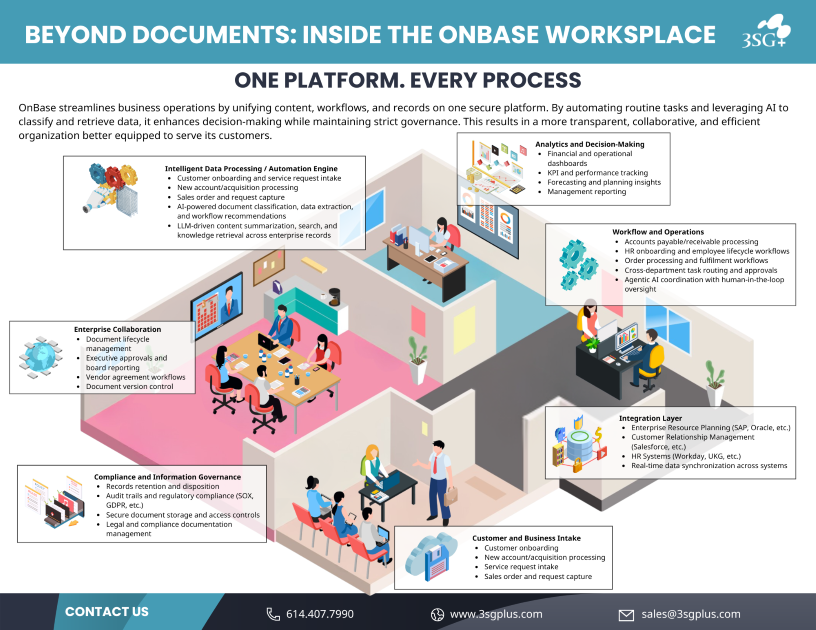
Download our infographic: “OnBase Use Cases Across the Corporate Enterprise” to see how you can bridge the gap between basic storage and full-scale enterprise automation.
Expanding Beyond the Back Office
While many associate content management with back-office administrative tasks, its true value shines when it touches customer-facing and revenue-generating departments. Customer onboarding and intake processes are often the first points of friction in a business relationship. A platform that streamlines these interactions through automated intake and processing creates a professional and efficient first impression. Furthermore, the system can manage the entire sales order lifecycle, from initial capture to final fulfillment workflows. By integrating these front-end activities with the core repository, organizations gain a 360-degree view of the customer journey. This visibility is not just a luxury; it is a necessity for maintaining a competitive edge in a market where customers expect immediate responses and personalized service.
Leveraging LLMs for Deep Knowledge Retrieval
One of the most significant advancements in modern content management is the integration of Large Language Models for content summarization and search. In an enterprise with millions of records, finding a specific piece of information can be like searching for a needle in a haystack. LLM-driven tools allow employees to perform natural language queries to retrieve knowledge across the entire enterprise record set. Instead of scrolling through hundreds of pages of vendor agreements or legal documentation, a user can ask the system to summarize the key terms of a contract or identify specific compliance risks. This capability transforms the platform from a silent archive into an active participant in the business’s intellectual life. It empowers staff at all levels to make informed decisions quickly, backed by the full weight of the organization’s historical data.
Strengthening Compliance and Information Governance
In an era of increasing regulatory scrutiny, a robust approach to compliance and information governance is non-negotiable. Managing the lifecycle of a document involves more than just keeping it; it involves knowing when and how to legally dispose of it. Automated records retention and disposition schedules ensure that an organization is not holding onto data longer than necessary, which reduces legal liability and storage costs. Additionally, maintaining comprehensive audit trails is essential for meeting standards such as SOX or GDPR. Secure document storage with granular access controls ensures that sensitive information is only available to those with a legitimate business need, protecting the organization from both internal and external threats. When governance is baked into the platform rather than treated as an afterthought, compliance becomes a byproduct of daily operations rather than a separate, grueling task.
Driving Results through Analytics and Visibility
Data is only useful if it can be interpreted and acted upon. By unifying content and workflows on a single platform, organizations can generate financial and operational dashboards that provide a real-time pulse of the business. These tools allow for KPI and performance tracking that was previously impossible when data was scattered across various spreadsheets and physical files. Management reporting becomes a streamlined process, providing leadership with the insights needed for accurate forecasting and planning. This level of transparency extends to executive approvals and board reporting, where the document version control and lifecycle management features ensure that every stakeholder is looking at the most current and accurate information. When everyone from the intern to the CEO is working from the same single source of truth, the entire organization moves in sync.
Maximizing the Employee Lifecycle
The benefits of a comprehensive platform also extend inward to the very people who power the company. HR systems like Workday or UKG are powerful, but they often lack the deep document management capabilities required for complex employee lifecycles. By integrating OnBase with these HR systems, companies can automate onboarding, manage employee records securely, and route tasks for approvals across different departments. This reduces the administrative burden on HR staff, allowing them to focus on talent development and employee engagement rather than filing paperwork. From the initial job application to the final exit interview, every document and decision is captured and preserved, creating a permanent and searchable record of the employee’s tenure.
Conclusion
Using only half of your enterprise content management system is more than just a missed opportunity; it is a significant drain on potential ROI. By embracing a unified platform that integrates AI-powered automation, real-time data synchronization, and advanced analytics, you can turn a simple storage tool into a strategic asset. The goal is to move past the limitations of traditional document management and enter a phase of intelligent operations where data works for you. Whether it is streamlining accounts payable, enhancing customer onboarding, or ensuring strict regulatory compliance, the capabilities of a fully realized OnBase environment are vast. It is time to stop settling for partial utilization and start demanding more from your technology investments.