

The transition from physical archives to a streamlined digital infrastructure is a fundamental requirement for operational resilience. Many organizations find themselves buried under the weight of fragmented, paper-heavy operations that stifle productivity and create significant security risks. To overcome these hurdles, leadership teams must move beyond simple scanning and embrace a formal document digitization roadmap. This strategic framework provides a phased execution plan to transition your organization into a scalable, structured digital environment where records are not just stored, but are actively working to support business goals. By understanding that knowing how to digitize is a matter of standards, while knowing when and where to start is a matter of strategy, businesses can bridge the gap between simple document conversion and true digital transformation.
Document Digitization: A Roadmap
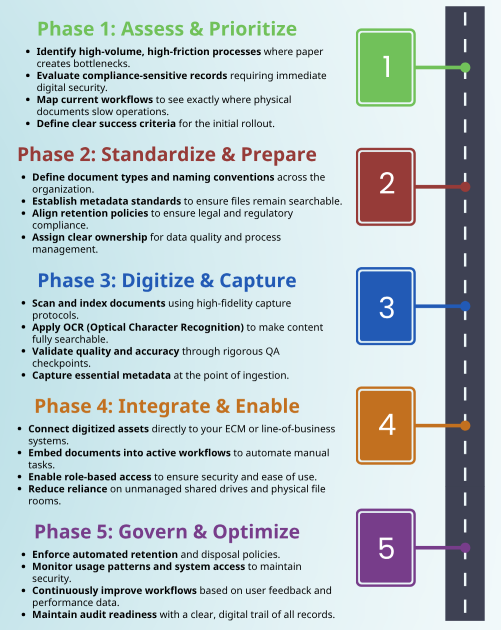
Phase 1: The Critical Importance of Assessment and Prioritization
The first step in any successful digital journey is a cold, hard look at the current state of your physical inventory and manual processes. You cannot digitize everything at once, nor should you. A successful roadmap begins by identifying high-volume, high-friction processes where paper creates significant bottlenecks. These are often the areas where staff spend hours searching for files or where physical hand-offs cause delays in customer service or internal approvals.
During this initial assessment phase, it is vital to evaluate compliance-sensitive records that require immediate digital security. Regulatory requirements for data privacy and record-keeping mean that some documents carry more risk than others if they remain in a physical, unencrypted state. By mapping current workflows, organizations can see exactly where physical documents slow down operations and create unnecessary overhead. This data-driven approach allows for the definition of clear success criteria for the initial rollout, ensuring that the project delivers measurable value from the very beginning. Without this foundation, digitization efforts often become aimless, leading to digital landfills where files are saved but never found.
Phase 2: Building Excellence through Standardization
Once the priorities are set, the focus must shift to the architectural side of digital records. Digital transformation fails when there is a lack of consistency. This is why Phase 2 centers on standardizing and preparing the environment. This involves defining specific document types like invoices, contracts, or HR records and establishing naming conventions across the entire organization. When every department uses the same language to describe their files, the barriers to cross-functional collaboration begin to disappear.
Establishing metadata standards is perhaps the most critical component of this phase. Metadata, such as dates, ID numbers, and subjects, ensures that files remain searchable and useful long after the initial scan. Furthermore, organizations must align their digital practices with retention policies to ensure legal and regulatory compliance. This means knowing exactly how long a record must be kept and when it can be legally destroyed. To maintain the integrity of this new system, clear ownership must be assigned for data quality and process management. When someone is responsible for the health of the digital ecosystem, the system remains a strategic asset rather than a liability.
Phase 3: The Mechanics of Digital Capture
The third phase is where the physical meets the digital: Digitize and Capture. This is more than just feeding paper into a tray; it is about using high-fidelity capture protocols to ensure that the digital version is as reliable as the original. High-resolution, industry-standard formats should be the baseline for every scan to ensure long-term legibility. However, an image alone is not enough for a modern workplace.
Applying Optical Character Recognition (OCR) is essential to make content fully searchable. OCR allows users to find documents instantly via search without needing to know specific filenames, which drastically reduces the time spent on administrative tasks. Quality assurance (QA) is another non-negotiable step in this phase. Rigorous QA checkpoints must be integrated to validate the quality and accuracy of every scan, ensuring no pages are missing or blurred. By capturing essential metadata at the point of ingestion, the organization ensures that the record is categorized and filed correctly from the moment it enters the digital stream.
Phase 4: Integration and Operational Enablement
Digitization reaches its full potential when the new digital assets are integrated directly into the heart of the business. In Phase 4, digitized assets are connected to enterprise content management (ECM) systems or other line-of-business applications. This connectivity allows documents to be embedded into active workflows, automating manual tasks that previously required physical intervention. For example, a digitized invoice can automatically trigger an approval workflow, reducing the need for mailroom transit or desk-to-desk delivery.
This phase also addresses security and accessibility. By enabling role-based access, organizations ensure that the right people have the right information at the right time without compromising sensitive data. This shift allows multiple departments to securely collaborate on the same record simultaneously, a feat impossible with physical paper. Ultimately, the goal is to reduce and eventually eliminate the reliance on unmanaged shared drives and physical file rooms, creating a single source of truth for the entire organization.
Phase 5: Governance and Long-Term Optimization
The final phase of the roadmap is an ongoing commitment to excellence: Govern and Optimize. Once the digital foundation is built, it must be protected and refined. This includes enforcing automated retention and disposal policies to prevent the build-up of ROT (redundant, obsolete, or trivial) data. Monitoring usage patterns and system access is also vital for maintaining security and identifying new ways to improve the user experience.
Continuous improvement is fueled by user feedback and performance data. As the organization grows, the digital workflows should evolve to meet new challenges. Maintaining audit readiness is a major benefit of this phase; a clear digital trail of all records ensures that the organization can respond to legal or regulatory inquiries with ease. A high-performing digital workplace is never finished; it is a living system that requires a clear strategy for long-term governance.
Download our comprehensive document digitization roadmap to access a phased execution plan that guides you through assessment, standardization, capture, integration, and long-term governance.
Assessing Your Organization's Digital Readiness
To know where you are going, you must first understand where you stand. A document imaging practices checklist serves as a maturity assessment to identify where your organization is succeeding and where there are opportunities for improvement. This assessment covers five key areas:
- Intake and Capture: Are documents captured at the point of entry, such as the mailroom or the field? Are responsibilities clearly defined?
- Quality and Searchability: Are you using high-resolution formats and full-text OCR? Is there a QA process in place?
- Metadata and Structure: Is your naming convention standardized? Can users find files without knowing the filename?
- Accessibility and Workflow: Are documents integrated into daily processes? Is access role-based?
- Governance and Continuity: Do you have a single source of truth? Are audit trails and retention policies active?
Areas without a checkmark represent opportunities to improve operational speed, reduce manual effort, and better support future ECM goals. Recognizing these gaps is the first step toward turning simple scans into strategic assets.
Use our “Document Imaging Practices Checklist” to identify where your organization is succeeding and where there are opportunities to improve operational speed, ensure compliance, and support future ECM goals.
Conclusion: Bridging the Gap to a Digital Future
Building a document digitization roadmap is about more than just technology; it is about organizational alignment and long-term vision. By following a structured, five-phase approach, businesses can move from the chaos of paper-heavy operations to the precision of a digital-first environment. This journey ensures that your digitization efforts improve your actual operations, not just your storage capacity.
3SG Plus bridges the gap between document conversion planning and execution, helping organizations navigate each phase of this roadmap with a structured and scalable approach. Whether you are just beginning to identify your high-friction processes or you are looking to optimize an existing digital archive, a focused strategy is the key to creating a high-performing digital workplace.