

Public agencies navigate complex landscapes where the demand for rapid service delivery frequently outpaces available internal resources. To bridge this gap, many government organizations are turning to a robust Accela configuration strategy to streamline operations and ensure long-term platform health. By focusing on native system capabilities rather than expensive, code-heavy customizations, agencies can effectively scale their civic services without a linear increase in headcount. This approach allows for a more agile response to legislative changes and community needs while maintaining a stable environment for staff and constituents alike.
The Hidden Cost of Reactive Configuration
The journey of digital transformation often begins with the best of intentions. An agency identifies a bottleneck like backlog in building permits or a new mandate for short-term rental tracking and moves quickly to build a solution within Accela. While this agility is commendable, making configuration decisions in isolation can lead to a fragmented ecosystem. Over time, these quick fixes accumulate, resulting in inconsistent workflows that confuse staff and complex rules that become a nightmare for administrators to manage.
When workflows are built without a cohesive strategy, reporting becomes a significant hurdle. Data that should provide insights into departmental performance becomes siloed or non-standardized, making it nearly impossible to generate the reliable performance metrics needed for budgetary justification and public transparency. This reactive cycle creates a system that feels like a constraint rather than a catalyst for civic excellence. Breaking free from this cycle requires a fundamental shift toward a configuration-first mindset that prioritizes scalability and supportability from the outset.
Configuration vs. Customization: Choosing the Path of Least Resistance
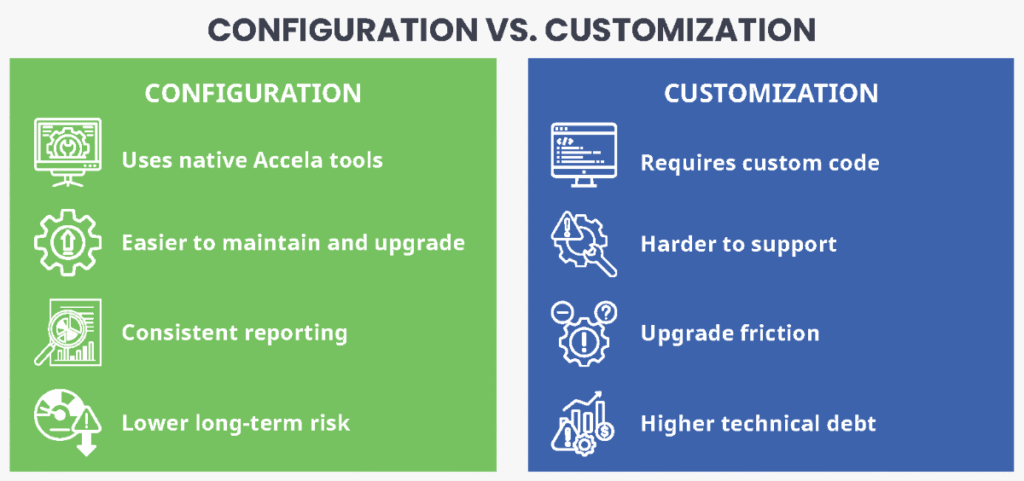
Understanding the distinction between configuration and customization is the cornerstone of a sustainable Accela configuration strategy. Configuration involves using the native tools and features provided within the Accela platform to tailor the experience to an agency’s specific needs. This includes defining record types, setting up standard workflows, and creating custom fields within the existing framework. Because these elements are built using the platform’s core logic, they are inherently easier to maintain and much simpler to upgrade when Accela releases new versions.
In contrast, customization involves writing custom code to force the system to perform functions it was not originally designed to do. While this can offer a highly specific user interface or behavior, it introduces significant upgrade friction. Every time the core platform is updated, custom code must be tested, debugged, and often rewritten, leading to higher technical debt and a constant reliance on specialized developers. By leaning into configuration, agencies reduce long-term risk and ensure that their system remains an asset that grows with them, rather than a legacy burden that prevents them from adopting new features
Stop making configuration decisions in isolation. Building a scalable agency requires a clear roadmap that distinguishes between short-term fixes and long-term value. Our Accela Configuration Strategy Overview provides a blueprint for:
- Defining the Configuration Challenge: Understand how isolated decisions lead to inconsistent workflows and reporting hurdles.
- Navigating Configuration vs. Customization: A side-by-side comparison of maintenance costs, upgrade friction, and technical debt.
- Applying Core Design Principles: Learn the essential rules for standardizing workflows and aligning configuration with reporting needs.
- Visualizing Success: See the specific outcomes of a configuration-first approach, from faster staff adoption to reliable performance metrics.
Download the full Strategy Overview PDF and start turning your configuration into an asset that supports your agency’s growth.
Core Principles for a Scalable Workflow
To build a system that scales without bloating the workforce, agencies must adhere to several core configuration principles. The first is to design workflows comprehensively before a single field is ever configured in the software. This involves mapping out the entire lifecycle of a permit or application, identifying every handoff, and ensuring that the digital process reflects the most efficient version of the real-world policy.
Standardization is the second pillar of a successful strategy. Agencies should aim to standardize processes across different departments wherever possible, allowing for variation only when a specific legal or operational requirement demands it. This standardize first approach makes training new staff significantly easier, as the user interface and logic remain consistent whether someone is processing a plumbing permit or a business license. Furthermore, all configuration decisions must be aligned with the end goal: reporting. If a data point isn’t being captured in a way that can be queried, its value to the organization is severely diminished.
Achieving Resilience Through Strategic Planning
The ultimate outcome of a well-executed configuration strategy is a resilient system that provides greater confidence in its longevity. When the system is built on native tools, staff adoption is faster because the interface is intuitive and consistent. Furthermore, the agency is no longer tethered to external development teams for every minor change. Instead, internal administrators can leverage the platform’s flexibility to plan for changes in policy or sudden spikes in application volume without fearing a system collapse.
This strategic resilience means that as the community grows, the agency can handle the increased load through automation and optimized workflows rather than simply hiring more clerks to manage a clunky interface. It transforms Accela from a mere database into a high-performance engine for civic service delivery. By documenting every decision and assumption made during the configuration phase, the agency also protects itself against institutional amnesia, ensuring that future administrators understand the why behind the system’s setup.
Turning Configuration Into Long-Term Value
A successful Accela configuration strategy is not a one and done project; it is an evolving practice. Agencies must periodically revisit their configuration decisions as their operational needs evolve and as Accela introduces new capabilities. This proactive maintenance ensures that the platform never becomes a constraint. By balancing immediate operational needs with long-term maintainability, agencies can ensure that their investment in Accela continues to pay dividends for years to come.
The goal is to create a digital infrastructure that is as dynamic as the city it serves. When configuration is treated as a strategic asset, the results are clear: reliable performance metrics, seamless upgrades, and a system that empowers staff to focus on high-value tasks rather than fighting with the software. This is how modern agencies scale their impact without scaling their costs.
Conclusion
Scaling civic services in an era of limited resources requires more than just better software; it requires a better strategy. By prioritizing configuration over customization and adhering to principles of standardization and documentation, your agency can build a version of Accela that is robust, easy to upgrade, and perfectly aligned with your reporting needs. This approach not only reduces technical debt but also builds staff confidence and ensures that your digital services can grow alongside your community.